Glass vs Stainless Steel vs Silicone for Food Storage

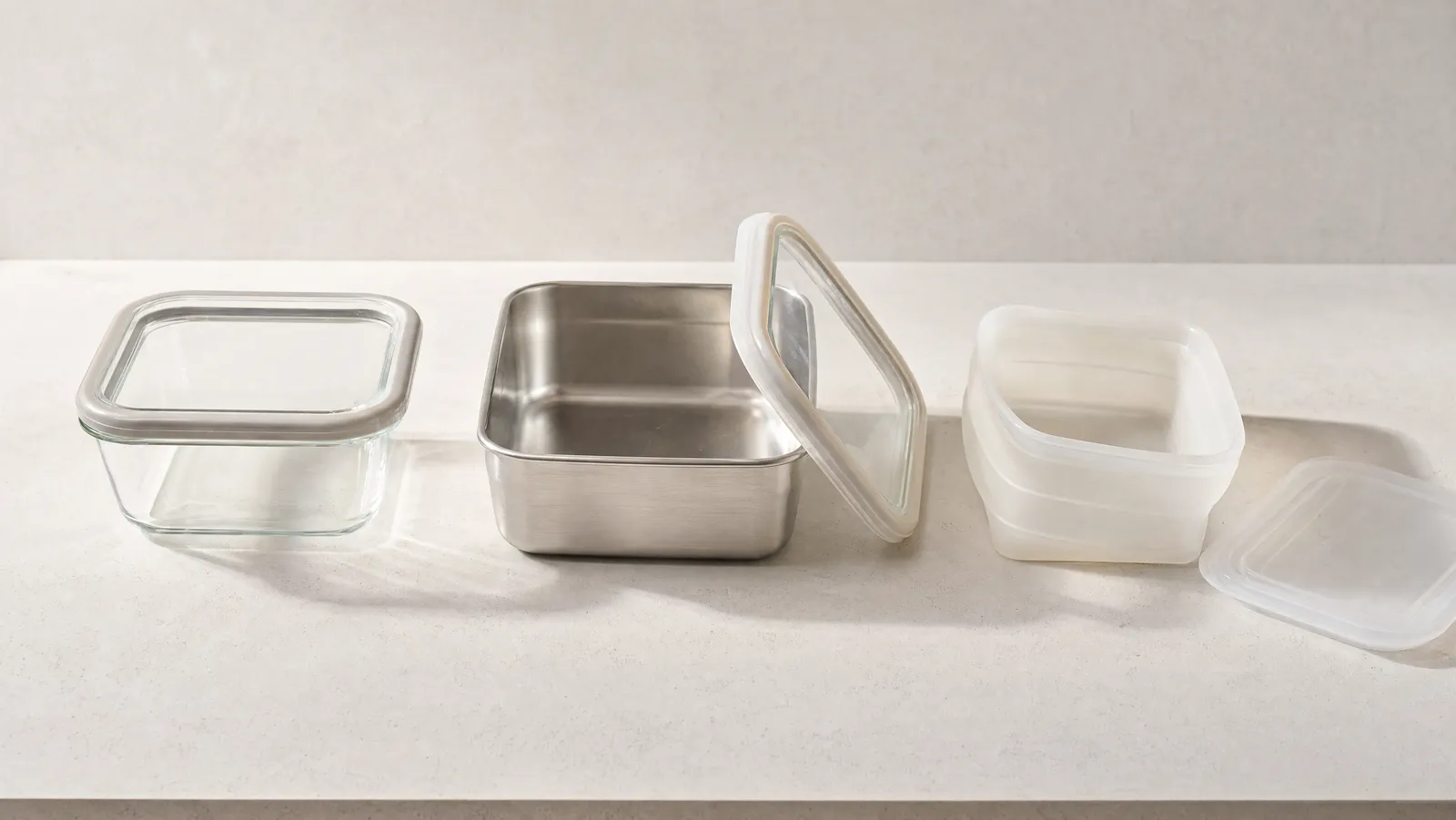
There is no single winner, and anyone who names one is selling you a set. Glass wins reheating and seeing what is inside. Stainless steel wins durability and blocking light. Silicone wins space, and is the only one of the three that bends. We may earn a commission when you buy through links on this page, at no cost to you.
We get the glass vs stainless steel food containers question more than any other in this series, usually from someone in an aisle holding two near-identical boxes. We scored all three on the same seven axes: thermal range, failure mode, air seal, weight and carry, light blocking, cleaning and odor, cost per litre. Getting plastic-free food storage into a kitchen is the pillar this sits under; the material question is the one underneath it. We did not test these sets; every product-specific line below is a labelled maker claim.
What glass, stainless steel and silicone actually are
Three words on these labels carry real information, and two carry less than you think.
Borosilicate against soda-lime glass. Soda-lime is ordinary bottle and jar glass; borosilicate is the lower-expansion formulation, and that is the whole of its reputation. ASM International, the materials society, states in its thermal shock demonstration that "the lower the coefficient - the less stress caused by sudden temperature changes", and that a heated borosilicate rod quenched in ice water shows "fewer overall cracks than with the soda-lime glass". Fewer cracks. Not none.
304 stainless, also sold as 18/8. According to worldstainless, the stainless steel programme of the World Steel Association, austenitic steels need "sufficient nickel or manganese to stabilise the austenite microstructure", and "a typical composition is 18 % chromium and 8 % nickel, as found in the popular AISI 304 grade" - which is where the 18/8 shorthand comes from. Per the Nickel Institute, 8 percent is about the minimum nickel that stabilises the austenitic structure at room temperature.
Platinum-cured silicone, and what LFGB means. Food-contact silicone sits under the FDA's rule for rubber articles intended for repeated use, 21 CFR 177.2600, which sets extraction limits rather than a grade of purity: refluxed in distilled water for seven hours, a food-contact surface must yield "total extractives not to exceed 20 milligrams per square inch", and in n-hexane, standing in for fatty food, the allowance rises to 175. LFGB is Germany's Food and Feed Code; the technical content for silicone sits in the German Federal Institute for Risk Assessment's Recommendation XV, which requires that elastomers "must release no more than 0.5 % volatile organic and no more than 0.5 % extractable components" and must not test positively for peroxides. That is what "platinum-cured" means in practice: a peroxide cure leaves by-products to drive off, a platinum cure has none.
You probably do not need to buy anything
Jars you already own, washed and matched to the portion you actually cook, cover most household storage, and that costs nothing. We earn nothing from that sentence, which is why it sits above the picks.
Two cases justify buying: the oven-to-table dish, where one vessel cooks, chills and reheats, and the lunch in a bag, where a failed lid costs you a laptop. Otherwise start with a cupboard audit; our tested picks and their compromises are in the best plastic-free food storage containers. Dry pantry goods are a different problem with a different answer, and we cover the best pantry storage jars for bulk and dry goods separately.
Thermal range, from freezer to oven
Silicone has the widest usable range, glass the narrowest, and steel a hole in the middle of its range. Urban Green states the borosilicate containers take the microwave and oven with the glass lid kept out of the oven, and the steel set microwave, oven, dishwasher, refrigerator and freezer; Sustainable Containables states its silicone is "freezer, oven, microwave, & dishwasher safe".
The number that matters is not the maximum temperature but the rate of change. Glass fails not because an oven is hot but because its outside and inside change temperature at different speeds - the stress ASM describes. The National Center for Home Food Preservation at the University of Georgia is blunt about the cold end: "Regular glass jars break easily at freezer temperatures," and the wide-mouth dual purpose jars it recommends instead qualify because they "have been tempered to withstand extremes in temperatures". The headspace figures are in how to freeze food without plastic.
Steel's hole is the microwave. The FDA's explainer says microwaves "are reflected by metal" and pass through glass, and that "generally, metal pans or aluminum foil should also not be used in a microwave oven, as the microwaves are reflected off these materials causing the food to cook unevenly and possibly damaging the oven." Urban Green says its steel containers can be microwaved under 10 minutes with the vent open. That is the maker's claim, not a tested fact, and not one we would act on. Treat steel as the fridge-to-oven-to-table material and reheat in something else.
How each material fails
All three should outlive a plastic box, so durability is the wrong axis; how they end is what differs.
- Glass shatters. Suddenly, at the weakest point rather than the point you hit, often into a sink of washing-up. NCHFP requires that freezer packaging "not become brittle and crack at low temperatures"; glass does not turn brittle in the cold, it simply breaks.
- Steel dents, and a dented container keeps working. Its real failure mode is chemical: Kamerud, Hobbie and Anderson, in the Journal of Agricultural and Food Chemistry in 2013, simmered tomato sauce in stainless steel and found nickel and chromium rose up to 26-fold and 7-fold after six hours, new steel leaching most of all. That is six hours of acidic cooking, not a night in the fridge, and we will not stretch it.
- Silicone tears. Sustainable Containables calls its material "durable & tear resistant" and covers manufacturing defects for two years. A tear is slow and visible: it leaks, and you know.
Pick the failure you would rather have, because you will get one of them.
The air seal and the weight, the axes with no published numbers
Every brand makes a seal promise and none shows its working. Urban Green describes a leak-proof air vent lid you close, press and lock; Sustainable Containables describes leakproof silicone lids. We found no standard, method or figure behind either, so we are not ranking them. Why the axis matters is sourceable: NCHFP's requirements put "durable and leakproof" and "easy to seal" alongside moisture-vapour resistance, and a smear of sauce on a rim defeats all three. Silicone's advantage is that you can press the air out before closing, which no rigid box allows.
Weight is the same story: neither listing publishes a filled weight, so we will not invent one. Glass is heaviest for the volume held, steel lighter at the same capacity, silicone lightest and the only one that packs down - the maker states its containers "collapse to 50 percent of their size". Glass and steel occupy the same volume empty as full, and in a small kitchen that is the cost nobody prices.
Light blocking is the axis nobody tests for
Here is the axis no comparison article scores, and the only one where the three are not close: steel blocks light completely, glass and clear silicone essentially none. One caveat straight from the listing: Urban Green's steel containers come with clear glass lids, so the body blocks light and the lid does not - stored lid-up under a light, the steel set is a partial barrier, not a sealed one.
Light is not cosmetic. In the Critical Reviews in Food Science and Nutrition review of lipid oxidation in low-moisture foods, Leann Barden and Eric Decker list light among the factors that "promote lipid oxidation in the initiation stage", and name heat, light and transition metals as what breaks lipid hydroperoxides into alkoxyl radicals, which in turn generate the volatiles you smell as rancid - the chemistry behind stale nuts, tired flour and off coffee. The same review notes packaging is used "to provide light and air barrier properties". Food packaging has treated light as a barrier problem for decades; kitchenware has not.
Cheryl Stancik, Susan Duncan and Philipp Niedenzu reported in Current Developments in Nutrition in 2019 that milk in the strongest light-protective packaging kept 83 percent of its riboflavin through a month in a fluorescently lit refrigerated case at 2,186 lux and 3 degrees Celsius, against 23 percent in control packaging with no light protection. In Food Science and Nutrition in 2015, Bianchi, Duncan, Webster and colleagues found soymilk in clear bottles lost 28.3 percent of its riboflavin over 36 days against 5.4 percent in foil-wrapped controls, with sensory differences detectable within 20 hours.
Now the honest part: those were lit retail cases, and your refrigerator is dark. Light blocking does not matter inside a closed fridge. It matters on a counter, an open shelf, a daylit pantry and a bag on a sunny desk - exactly where clear containers live. For anything fatty, nutty, floury or ground, steel does a job glass cannot, and no listing will tell you so.
Cleaning, staining and odor retention
Glass and steel are both dishwasher-safe per Urban Green, non-porous and indifferent to curry. Silicone's reputation here rests on regulation rather than anecdote. The two numbers in 21 CFR 177.2600 say why: up to 20 milligrams per square inch of extractives into refluxing water, but up to 175 into refluxing n-hexane, the fatty-food simulant. The regulator's own allowance is nearly nine times larger for fat than for water, which tells you which direction traffic runs between silicone and an oily sauce.
We did not test odor retention and found no published test of it, so we will not put a number on it. NCHFP's requirement that packaging "protect foods from absorption of off flavors or odors" exists for a reason, and 177.2600's instruction to cleanse rubber articles thoroughly before first food contact is worth following on a new box. Our rule: oily and spiced food goes in glass or steel, and the silicone keeps the rice.
Cost per litre, and the one we cannot calculate
From the published volumes and prices:
- Glass. 49.99 dollars as of October 2026 for four 35 oz containers. 35 fluid ounces is about 1.04 litres, so the set holds roughly 4.14 litres: 12.50 dollars a container, about 12.07 dollars a litre.
- Silicone. 44.99 dollars for three 4.9-cup containers, about 1.16 litres each and 3.48 litres total: 15.00 dollars a container, about 12.94 dollars a litre.
- Steel. 49.99 dollars for four, so 12.50 dollars each, and no cost per litre at all, because the listing does not agree with itself.
That is not a footnote. The title calls the steel set "Rectangle Shape, set of 4" while the what-you-get bullet describes a "4 Pack of Round Stainless-Steel Container set ... with volume of: 42oz, 28oz" - two volumes for a four-piece set, round against rectangle. We are not choosing whichever version suits the article. Buy the steel knowing you do not know its shape or capacity until the box arrives.
Glass vs stainless steel vs silicone on seven axes
Each axis, with the material that wins it and the material that loses it.
- Thermal range. Wins: silicone. Loses: glass.
- Failure mode. Wins: steel. Loses: glass.
- Air seal. Wins: silicone. Loses: nobody publishes a number.
- Weight and carry. Wins: silicone. Loses: glass.
- Light blocking. Wins: steel. Loses: glass and clear silicone.
- Cleaning and odor. Wins: glass and steel. Loses: silicone.
- Cost per litre. Wins: glass, 12.07 dollars. Loses: silicone, 12.94 dollars.
The one job each material loses at
- Glass loses at being carried. Heaviest of the three, the only one that turns a dropped lunch into an injury, and it loses on light too.
- Stainless steel loses at the microwave. Follow the FDA on metal pans, not the maker. It also loses at telling you anything: an opaque box is a sealed question, so labelling matters more here than with the others.
- Silicone loses at price and at fat. Dearest per container, and the regulator's own extraction allowances show fatty food is the hard case for a rubber article. It is also still a polymer, the argument we worked through in is it safe to store food in plastic.
The same brand at the same 49.99 dollars, glass against steel
This is the comparison's one piece of luck. The Urban Green glass four-pack and the Urban Green steel four-pack are both 49.99 dollars as of October 2026, same maker, same pack size, one variable changed. Urban Green states quality borosilicate bodies for one and premium 304 stainless for the other, both under clear glass lids in silicone frames with an air vent. Urban Green calls the glass set's lid "durable semi-tempered glass"; the steel listing says only "clear glass lid with Silicone frame", so we are not extending the semi-tempered wording to it. Semi-tempered is the maker's word either way, with no published specification behind it we could find.
The glass costs you three things: it is the only material here that can shatter, the heaviest to carry full, and being clear it gives the food no protection from light. The steel costs you two, both from its own listing. It contradicts itself about shape and volume, and we are reporting that rather than resolving it, and the microwave claim is Urban Green's, not ours. Steel earns its 49.99 dollars on the light its body blocks and on denting instead of shattering.
Silicone food storage safety, and the price per container
The Sustainable Containables three-pack is 44.99 dollars as of October 2026 for three 4.9-cup containers: 15.00 dollars each, the highest per-container price here. The maker states they are see-through food-grade platinum silicone with leakproof lids, LFGB certified, collapsing to 50 percent of their size, and freezer, oven, microwave and dishwasher safe.
That LFGB line is the most informative thing on the listing, because it points at BfR Recommendation XV's measured limits rather than at an adjective. What 15.00 dollars a container buys is the only box here that gets smaller when it is empty. What you give up: the dearest price per litre of the three at about 12.94 dollars, no light blocking at all, and a polymer wall where glass would have given you a mineral one.
The bottom line
Buy the material for the job rather than for the identity: steel for anything fatty or stored in the light, glass for anything you reheat or want to see, silicone for anything you carry or cannot find room for.
- Buy glass if you cook, chill and reheat in one dish and want to see into the fridge. Accept the weight, the shatter risk and the light.
- Buy stainless steel if you keep oils, nuts, flours, ground coffee or leftovers on an open shelf or in a bag, and will label everything and reheat elsewhere.
- Buy silicone if cupboard space is the binding constraint, and you accept 15.00 dollars a container and keeping oily food out of it.
Most kitchens want two of the three. Audit the jars you own, add steel for the light-sensitive foods, and buy silicone only when something genuinely has to collapse. The rest of the argument, aisle by aisle, is in plastic-free storage across the kitchen.
What we tested

The all glass reference point at the same price as the steel
- Material
- Borosilicate, 304 Steel & Silicone
- Credentials
- Plastic-freeMaterial-led
Urban Green states this set is microwave safe with the glass lid on and the air vent open, so you can reheat and still watch what you are reheating - something the steel cannot offer, because microwaves pass through glass and, as the FDA puts it, are reflected by metal.
No major drawbacks noted in testing.
49.99 dollars as of October 2026 for four 35 oz containers, which works out at 12.50 dollars each and about 12.07 dollars a litre. Urban Green states the body is quality borosilicate glass and the lid is durable semi-tempered glass with a premium silicone frame and a lockable air vent, markets the set as "No Plastic, Not Plastic, Plastic Free!", and says the containers are safe for microwave and oven while the glass lid is not for oven use. Its job here is to be the control: same brand, same pack size and same price as the steel set, with only the body material changed. The costs are the ones glass always carries - it is the one material on this page that can shatter, it is heavy to carry full, and being clear it gives the food inside no protection from light.

The same brand and the same 49 99 dollars with only the body material changed
- Material
- Borosilicate, 304 Steel & Silicone
- Credentials
- Plastic-freeMaterial-led
The only pick on this page whose body blocks light completely, which is the axis no comparison article scores and the one that decides how fast a fat or a vitamin degrades on a lit shelf.
No major drawbacks noted in testing.
49.99 dollars as of October 2026 for a four-pack, identical in brand, pack size and price to the glass set above, which is what makes this page a material comparison rather than a price comparison. Urban Green states the bodies are premium 304 stainless steel with clear glass lids in silicone frames, describes the set as "Plastic free, BPA Free", and says it can be used in microwave, oven, dishwasher, refrigerator and freezer, with the lid kept out of the oven and microwave runs held under 10 minutes. Two costs we will not smooth over. The listing contradicts itself: the title says "Rectangle Shape, set of 4" while the what-you-get bullet says "4 Pack of Round Stainless-Steel Container set ... with volume of: 42oz, 28oz", so we cannot tell you the shape or the per-container volume, and we will not pick whichever version reads better. And we would not act on the microwave claim, because the FDA says metal pans should generally not be used in a microwave oven.

The only one of the three that collapses at the highest price per container
- Material
- Borosilicate, 304 Steel & Silicone
- Credentials
- Plastic-freeMaterial-led
Nothing else on this page gets smaller when it is empty. The maker says these collapse to 50 percent of their size, which is the one storage problem glass and steel cannot solve at any price.
No major drawbacks noted in testing.
44.99 dollars as of October 2026 for three 4.9-cup containers, which is 15.00 dollars each and about 12.94 dollars a litre - the highest per-container price in this comparison, and that is the honest headline for silicone. Sustainable Containables states the containers and leakproof lids are heavy-duty see-through food-grade platinum silicone, "durable & tear resistant", BPA-free, BPS-free and phthalate-free, that the premium silicone is LFGB certified, that they collapse to 50 percent of their size and are freezer, oven, microwave and dishwasher safe, under a 2-year warranty against manufacturing defects. Three costs: 15.00 dollars a container is the dearest here, see-through means it blocks no light at all, and it is a polymer, so if you left plastic behind over the chemistry rather than the bin, this answers the question only partly.
Compared, side by side
| Spec | The Glass BaselineUrban Green Glass Food Storage Containers with Glass Lids, 4 Pack, 35 oz | The Stainless Steel BaselineUrban Green Stainless Steel Food Containers with Glass Lids, 4 Pack | The Silicone BaselineSustainable Containables Premium Silicone Collapsible Food Storage Containers, 4.9 Cups, 3 Pack |
|---|---|---|---|
| Verdict | Solid | Solid | Solid |
| Composite | 3.8/5 | 3.8/5 | 3.8/5 |
| Materials | 4.1 | 4.1 | 4.1 |
| Health | 3.9 | 3.9 | 3.9 |
| Durability | 4.3 | 4.3 | 4.3 |
| End-of-life | 2.8 | 2.8 | 2.8 |
| Price | — | — | — |
| Get it | Check price | Check price | Check price |
How we score
What it’s made of.
Chemistry you’ll touch.
How long it lasts.
Where it goes after.
Each pick scores 0–5 on the four axes above, weighted into the composite verdict at the top. Scores are derived from what a product is verifiably made of and certified as — not how green its label looks.
About the author
Ruth Lopez
I'm Ruth Lopez and I'm a lover of nature and the environment. I'm very passionate about finding eco friendly products that don't damage the environment and also support companies that have the same philosophy.