Zero Waste Bathroom Cleaning Without the Plastic Bottles

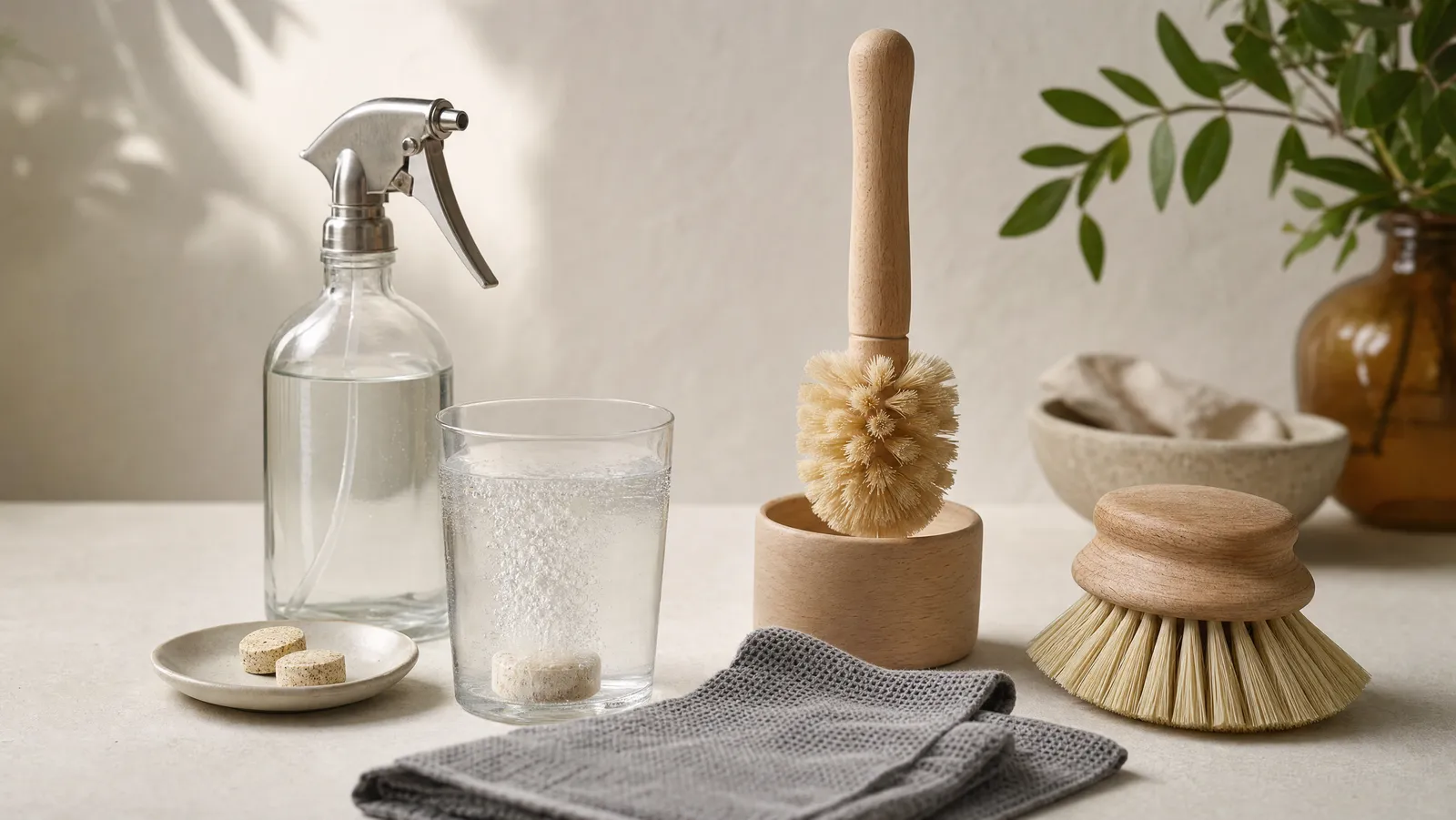
Zero waste bathroom cleaning comes down to one swap that most guides bury halfway down the page: stop buying the bottle. Keep one refillable spray bottle, drop in a tablet, fill it from the tap two feet away. That single change deletes the plastic, the freight and roughly four products from under your sink. Eco-Friendly Review is reader-supported, so if you buy through our links we may earn a small commission, at no extra cost to you.
Here is the stance that shapes everything below, and it is a mildly contrarian one: the waste win here comes from the format, not the label. A refillable bottle you keep for a decade beats a beautifully branded "plant-powered" single-use bottle every time, even when the second one has a leaf on the front. Most of what is sold as eco cleaning is a marketing layer applied to the same plastic trigger bottle. If you are working through a low-waste bathroom room by room, the cleaning cupboard is the cheapest win available, because the fix is mostly subtraction.
The Five-Piece System That Replaces the Whole Shelf
Look under most bathroom sinks and you will find seven to ten bottles: a tub-and-tile spray, a mildew spray, a toilet gel, a glass cleaner, a wipe tub, an air freshener and something bought in a panic in 2022 that nobody can identify.
The room does not need any of that. Here is the entire kit:
- One glass spray bottle for all-purpose cleaner — sink, counter, tile, toilet exterior, floor.
- One glass spray bottle for glass — mirror and shower screen only.
- A stack of refill tablets for each, stored in the cabinet instead of under it.
- Two brushes: one for the toilet, one for the tub, tile and grout.
- A pile of reusable cloths and one microfiber or waffle-weave cloth for glass.
Five categories, two of which are the same bottle bought twice. Everything below explains what each part does and where it falls short.
Most of a Bottle of Bathroom Cleaner Is Water
Unilever's Cif ecorefill is a small cartridge of concentrate you dilute into a bottle you already own. According to Dezeen's coverage of the launch, that design results in 97 per cent less water being transported. Unilever's Dove concentrate refills, documented in a US Plastics Pact case study, ship roughly 80 per cent less water per refill. Seventh Generation's EasyDose ultra-concentrated detergent, per the brand's own launch announcement, uses 60 per cent less plastic, 50 per cent less water, and weighs 75 per cent less than its standard 100 oz bottle.
Read those numbers backwards and you have the case for refillable cleaning tablets in one line: the thing being trucked across the country in that trigger bottle was mostly water you already have, plumbed into the room where you use it.
The bottle itself is the other half. According to the EPA's most recent Facts and Figures data, the United States generated 14.5 million tons of plastic containers and packaging in 2018, and recycled almost 2 million tons, or 13.6 per cent of it. Even HDPE natural bottles — the milk-jug plastic, the good stuff, the material most likely to actually get reprocessed — came in at 29.3 per cent. So the honest expectation for a cleaning bottle you put in the blue bin is that it probably will not be recycled. Not buying it is the only version of this that works reliably.
"Natural" and "Non-Toxic" Are Marketing Words, Not Standards
The eco cleaning aisle sells a feeling, and the feeling is priced.
According to the US Federal Trade Commission's Green Guides, a marketer claiming a product is non-toxic should hold competent and reliable scientific evidence that it is non-toxic for both people and the environment — and the FTC treats unqualified general claims like "eco-friendly" or "green" as very hard to substantiate, because they imply broad environmental benefits across the product's whole life. The guides exist precisely because these words get used loosely.
"Natural" is looser still. In our reading of how it appears on cleaning labels, it carries no agreed definition and no certifying body — it is a positioning word, and it is frequently attached to a formula sold in exactly the same virgin-plastic bottle as the mainstream product next to it on the shelf.
None of which means these products are bad. It means the label is not where the environmental difference lives. Judge the package, not the adjective. A non toxic bathroom cleaner sold as a compostable-wrapped tablet is a different proposition from one sold as 16 ounces of pre-diluted liquid in polypropylene, even when the ingredient lists are near-identical.
Start With the Bottle You Keep
Everything in this system hangs off one durable bottle, so buy that first and buy it once.
We use glass spray bottles rather than reusing an old plastic trigger bottle, and the reason is unglamorous: glass does not stain, cloud or hold the smell of whatever lived in it last. Reused plastic bottles get funky, and they crack at the shoulder eventually, which is how people end up back in the cleaning aisle.
Two practical notes. First, buy two. One gets all-purpose, one gets glass, and mixing them up is the fastest way to streak a mirror. Second, label them properly — the Vine Creations set ships with ten waterproof pre-printed labels plus chalk labels and a marker, which kills the most annoying failure mode of any refill system: an unlabelled bottle of clear liquid that could be anything.
A trigger that switches between mist and stream also matters more than it sounds. Mist for counters and mirrors, stream for the back of the toilet and into grout lines.
The Refills: One Tablet, One Bottle, No Freight
Here is the part where we decline to oversell. Refill tablets do not clean better than the spray they replace. They clean about the same. What they remove is the bottle, the water and the truck — that is the entire pitch, and it is enough. Anyone telling you a tablet outperforms conventional bathroom spray is selling, not testing.
For everyday surfaces we run Tirtyl multi-surface tablets: one tablet dissolves in tap water to make 16 fl oz, and a 12-pack yields 192 fl oz total. The formula contains no ammonia, sodium hydroxide or chlorine, which matters for a small unventilated room, and Tirtyl rates it for benches, tiles, glass, floors, appliances and bathrooms. Tirtyl also states that all of its ingredients appear on the EPA's Safer Chemical Ingredients List, and that it funds collection of ocean-bound plastic through Plastic Bank at one 16 fl oz bottle-equivalent per tablet sold — both are the manufacturer's claims, passed on as such. The compostable individual wrappers are the genuinely nice detail: the refill leaves nothing behind at all.
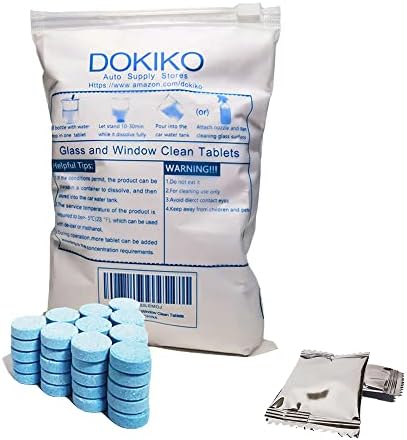
For the mirror and shower screen we keep a second bottle loaded with DOKIKO glass cleaner tablets. All-purpose spray on glass is where streaks come from; a neutral glass formula fixes it. Fifty tablets make 800 fl oz, an absurd amount of glass cleaner for the shelf space. DOKIKO advertises a 95 per cent reduction in plastic waste and up to 95 per cent cost savings against bottled cleaner — those are the brand's marketing figures, not ours, and we would treat both as ceilings.
If this logic feels familiar, it should. It is the same "ship the concentrate, not the water" argument running through the oral-care aisle, where we looked hard at whether toothpaste tablets are worth it and reached a similarly qualified answer: the format wins, the performance is a wash.
The Toilet Corner
Two things live in this corner, and only one of them is a cleaner.
The first is the brush. A plastic toilet brush is a disposable object pretending to be equipment — it goes floppy, it discolours, and nobody has ever repaired one. The Redecker union fiber toilet brush is the opposite bet: untreated beechwood, 14.5 inches, extra-stiff union fiber bristles, handcrafted by a German brush house working since 1935. Be clear-eyed about the trade-off, though — it is one piece, with no replaceable head. When the bristles finally go, the whole brush goes, so care is not optional: rinse it in lukewarm water, blot it, and hang it bristles-down to dry rather than standing it in a wet holder, which is what softens an untreated wooden handle.
All-purpose spray plus that brush handles a normally-used bowl, so the dedicated toilet gel is another product you get to delete. Hard-water scale is a descaling job rather than a daily-cleaner job — and it is exactly where people reach for a strong acid, so read the safety section below first.
The second thing in this corner is not a cleaner at all. The best bidet attachments are the other hardware change worth making here, and they cut the paper volume around the toilet in the first place.
Tub, Tile and Grout
Grout is where plastic-free cleaning gets tested, because grout is a mechanical problem, not a chemical one. No spray dissolves it clean; something has to scrub.
The Naturolic wooden scrub brush set is our pick for that job — two brushes, wood handles, tampico bristles. Tampico is fiber from the agave lechuguilla of northern Mexico, and per fiber suppliers including Enkev it is valued for its stiffness, strength, high water absorption and resistance to heat and chemicals. In plain terms: it holds its shape wet and it has bite on grout. Naturolic says it lifts dirt without scratching tubs and tile; we would still test a discreet corner of an older acrylic tub first, because that is the maker's claim and finishes vary.
The peanut-shaped handle is the underrated part: scrubbing with a flat sponge is a wrist-first motion, while a shaped handle lets you push from the arm. And when these wear out, wood and plant fiber compost, which a plastic scrubber does not.
Cloths, Not Rolls
The last piece costs almost nothing: a stack of reusable cloths. Cotton or bamboo for general wiping, one waffle-weave or microfiber cloth reserved for glass, a basket to throw them in until laundry day.
Paper towels and disinfecting wipes are the highest-frequency waste in most bathrooms and the easiest to stop buying, because a damp cloth genuinely beats a shredding paper sheet on a mirror — the argument we made at length in why I've stopped using paper towels in favor of dishcloths. Keep bathroom cloths visually separate from kitchen ones; a different colour is enough.
Where DIY Works, and Where It Wrecks Things
DIY cleaner recipes are the default advice in this niche, and they are half right.
Where vinegar genuinely works: hard-water and soap-scum deposits on glazed ceramic tile, glass shower doors, chrome fixtures and shower heads. It is an acid, and limescale is a base. This is real chemistry, not folklore.
Where vinegar does damage: natural stone. Marble, travertine and limestone are calcium carbonate, and acids etch them — a dull, rough patch where the polish has been chemically eaten away. Stone-care specialists are unanimous that this is not reversible with more cleaning, and recommend a pH-neutral stone cleaner instead. If your bathroom has a marble threshold, a travertine floor or a stone vanity top, keep vinegar off it entirely.
Where bicarbonate of soda works: as a mild abrasive for soap scum and a light odour absorber. That mildness is the point and the limit — we keep it off glossy acrylic and plastic shower doors, where any fine abrasive can dull the finish over repeated use.
And the safety line, stated once. Never mix cleaning products. The CDC's guidance on cleaning with bleach is blunt: never mix bleach with ammonia or any other cleaner, because it can release vapours that are dangerous to breathe. The Washington State Department of Health spells out the chemistry: mixing bleach with ammonia produces chloramine gases, and mixing chlorine bleach with an acid — which includes vinegar and many toilet-bowl and descaling products — gives off chlorine gas. Both are hazardous to breathe in a small, poorly ventilated room — which describes almost every bathroom. One cleaner at a time, rinse between products, open the window.
What the System Costs
Per-product prices, all as of August 2026. No headline savings figure, because we do not know what you were buying before.
- Glass spray bottles, 2-pack: 19.97 dollars. A one-time purchase; the ongoing cost is zero.
- Tirtyl multi-surface tablets, 12-pack: 16.95 dollars for 192 fl oz of finished spray, which works out to roughly 1.41 dollars per 16 oz bottle-equivalent.
- DOKIKO glass tablets, 50-pack: 7.99 dollars for 800 fl oz, or about 16 cents per bottle-equivalent.
- Redecker toilet brush: 22.99 dollars, against roughly 5 to 10 dollars for a plastic one. It only pays if it outlives three or four of them — that is the bet.
- Naturolic scrub brush set: 21.49 dollars for two brushes.
Read that honestly: the all-purpose tablet is priced like mid-range supermarket spray, not below it. The glass tablets are the clear cost win, the brushes are a bet on durability. You are buying the format, and sometimes paying a small premium for it.
The Shelf You End Up With
Two bottles, two boxes of tablets, two brushes, a stack of cloths. Nothing under the sink that needs a childproof cap, nothing that ships water across three states, nothing you will throw away this year.
The smallest starting move: buy the glass bottles and one pack of all-purpose tablets, then let the bottles already under your sink run out rather than binning them. Finishing what you own is a genuine waste win. Replacing it is a purchase.
Then work outward. The cleaning cupboard is one corner of a room full of packaging, and it is the corner where the case is clearest — our zero waste bathroom guide walks the rest of the swaps, in the order they are actually worth making.
What we tested

The refillable bottle the whole system hangs on
- Material
- Refill Tablets & Wood Brushes
- Credentials
- RefillablePlastic-free
A proper trigger that mists evenly instead of spitting, and the printed labels mean you stop guessing which bottle is the bathroom one.
No major drawbacks noted in testing.
Buy the bottle once and every refill after it is tap water plus a tablet. Two fortified 16 oz glass bottles, lead-free, with an adjustable nozzle that switches between mist and stream and a no-leak mechanism. Glass is the right call here because it will not cloud, stain or hold the smell of whatever was in it last, the way a reused plastic trigger bottle does. Ten waterproof pre-printed labels come in the box, plus two chalk labels and a white marker.

One tablet 16 ounces of bathroom spray no bottle
- Material
- Refill Tablets & Wood Brushes
- Credentials
- RefillablePlastic-free
Dissolves cleanly, handles tile and glass alike, and the compostable wrapper means the refill itself leaves nothing in the bin.
No major drawbacks noted in testing.
The workhorse refill. Twelve tablets, each dissolving in tap water to make 16 fl oz of multi-surface cleaner — 192 fl oz in total from a box that fits in one hand. Tirtyl rates the formula for benches, tiles, glass, floors, appliances and bathrooms, and it contains no ammonia, sodium hydroxide or chlorine. Each tablet is wrapped in home-compostable packaging, and the tablets work in any spray bottle you already own.
Streak free mirror spray for pennies a bottle
- Material
- Refill Tablets & Wood Brushes
- Credentials
- RefillablePlastic-free
Genuinely streak-free on shower glass, and fifty tablets is enough refills that you stop thinking about glass cleaner for a couple of years.
No major drawbacks noted in testing.
The bathroom mirror and the shower screen are the two surfaces where an all-purpose spray tends to leave streaks, which is why we keep a second bottle. Fifty tablets, each making 16 fl oz — 800 fl oz of glass cleaner from a pack small enough to live in the cabinet rather than under the sink. The neutral formula is intended for mirrors, glass shower doors, windows and windshields, and the tablet format is plastic-free.

A wood and plant fiber brush built to be the last one you buy
- Material
- Refill Tablets & Wood Brushes
- Credentials
- RefillablePlastic-free
Stiffer than it looks, and it ages well if you hang it bristles-down instead of parking it in a puddle.
No major drawbacks noted in testing.
The all-plastic toilet brush is a landfill item with a short life. This is the opposite proposition: an untreated beechwood handle 14.5 inches long, extra-stiff union fiber bristles that work wet or dry, and a maker, Bürstenhaus Redecker, that has been handcrafting brushes in Germany since 1935. It is one piece — there is no replaceable head — so the care matters: rinse in lukewarm water, blot, and air dry bristles-down so the handle does not soften.

Tampico bristle scrubbers for the tub tile and grout
- Material
- Refill Tablets & Wood Brushes
- Credentials
- RefillablePlastic-free
The peanut handle is far kinder on the wrist than a flat-backed sponge, and tampico keeps its bite long after a cheap plastic brush has gone floppy.
No major drawbacks noted in testing.
Tampico is the agave fiber doing the actual work here, and Naturolic says it lifts dirt and grime without scratching tubs and tile. The peanut-shaped wooden handle is shaped to cut wrist strain when you are leaning into grout, and the brushes work wet or dry across tubs, showers, tile, sinks and floors. Construction is plastic-free — wood plus natural fiber — and it is sold as a set of two.
The top three, compared
| Spec | Best Refillable BottleVine Creations Glass Spray Bottles (2-Pack, 16 oz) | Best All-Purpose RefillTirtyl Multi-Surface Cleaner Refill Tablets (12-Pack) | Best for MirrorsDOKIKO Glass Cleaner Refill Tablets (50-Pack) |
|---|---|---|---|
| Verdict | Buy | Solid | Buy |
| Composite | 4.5/5 | 3.9/5 | 4.5/5 |
| Materials | 5.0 | 4.7 | 5.0 |
| Health | 4.4 | 3.9 | 4.4 |
| Durability | 5.0 | 3.7 | 5.0 |
| End-of-life | 3.2 | 2.8 | 3.2 |
| Price | — | — | — |
| Get it | Check price | Check price | Check price |
How we score
What it’s made of.
Chemistry you’ll touch.
How long it lasts.
Where it goes after.
Each pick scores 0–5 on the four axes above, weighted into the composite verdict at the top. Scores are derived from what a product is verifiably made of and certified as — not how green its label looks.
About the author
Ruth Lopez
I'm Ruth Lopez and I'm a lover of nature and the environment. I'm very passionate about finding eco friendly products that don't damage the environment and also support companies that have the same philosophy.