Zero Waste Period Care and How Cups Discs and Underwear Compare

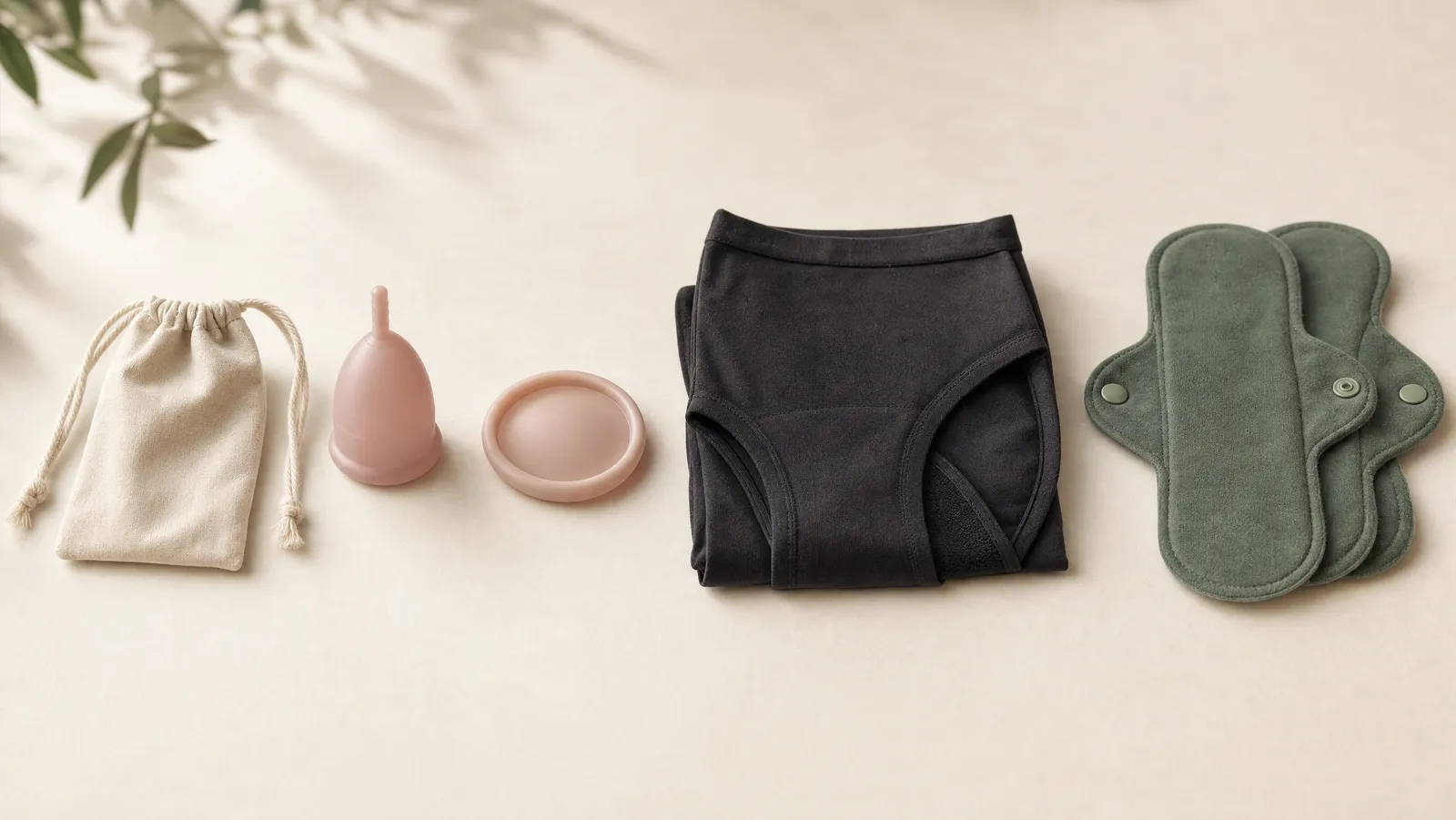
Zero waste period products are the reusable replacements for disposable pads and tampons: menstrual cups, menstrual discs, period underwear and cloth pads. All four get washed and used again for years. All four cost more on day one and less over any horizon longer than a few months. None of them is best for everyone — the differences here are anatomical, not moral.
Eco-Friendly Review is reader-supported, so if you buy through our links we may earn a small commission, at no extra cost to you.
We are not going to tell you what to put in your body. What we can do is set the four formats side by side — where each sits, how much it holds, what it asks you to learn, and what the laundry looks like. This is the period-care chapter of a plastic-free bathroom, and the chapter where format matters far more than brand.
One ground rule first. For anything medical — wear times, existing conditions, contraception, recovery — the product's insert and your clinician outrank us.
Why Zero Waste Period Products Are Worth the Bother
The disposable numbers are large enough that they do not need embellishing. According to a peer-reviewed perspective by Aujla and colleagues published in the Bulletin of the World Health Organization, a person can expect to use approximately 10,000 menstrual products in their lifetime, and pads and tampons are "now made of over 90% plastic." The same paper reports that in Europe and the United States over 80 percent of menstrual products end up in landfill, where disposable pads may take 500 to 800 years to break down.
The carbon side points the same way. Zero Waste Scotland's analysis of the carbon impacts of menstrual products found that a person switching from tampons to a menstrual cup would have 16 times less carbon impact, saving around 7 kg of CO2e over a year. It also flags the honest asterisk: for reusables, washing and cleaning are a meaningful share of the total, so how you launder matters.
There is a wallet argument too. ISSA, citing the market research firm Circana, reports that since 2019 the average price of a pack of sanitary pads has risen 41 percent and tampons 36 percent, with NielsenIQ data showing US unit sales down 12 and 16 percent since 2020. Disposables are getting dearer, and people are buying fewer of them.
How the Four Reusable Period Products Actually Differ
Strip away the marketing and only four variables matter.
- Where it sits. A cup sits in the vaginal canal. A disc sits further back, in the vaginal fornix. Underwear and cloth pads sit outside the body entirely.
- What it holds. Discs hold the most — FLEX rates its disc at up to 70 mL, or six super tampons. Cups hold less and are sized by flow. Underwear and pads absorb rather than collect, so capacity depends on the garment.
- What it asks you to learn. Cups take a cycle or two, discs take a different technique again, and underwear and pads take nothing at all.
- What the care looks like. Silicone gets rinsed, washed and periodically sanitized. Fabric goes in the laundry, which means a wet bag you actually have to carry.
Everything else — colour, brand, patented rim shapes — sits on top of those four. Pick the row you can live with, then pick a product in it.
Menstrual Cups: the Format Most People Try First
A cup is a small silicone bell you fold, insert, and let spring open so it seals against the vaginal wall. It collects rather than absorbs, which is why capacity is quoted in millilitres rather than "regular" and "super."
The evidence base is better than most people assume. A 2019 systematic review and meta-analysis in The Lancet Public Health pooled 43 studies covering 3,319 participants. In the four that compared cups directly against usual products for leakage (293 participants), leakage was similar in three and significantly less with the cup in one. That is a functionality finding, not a promise about your body.
The LENA cup is the one we would hand to a first-timer: medical-grade silicone, a patented shape offered in Small and Large so size is picked by flow and anatomy rather than hope, and instructions written for someone who has never done this. LENA rates it for up to 12 hours of wear — the maker's number, to be checked against the insert in your box. LENA also states one cup can replace 400 or more disposables and is designed for up to 10 years of use. Those are LENA's claims from its own listing, not study findings, and we have not tested a cup for a decade.
The failure modes are real and rarely advertised. Getting a seal takes practice, emptying in a public restroom is a logistics puzzle the first few times, and a firm cup can press on the bladder in a way no amount of enthusiasm fixes.
The Softer Cup, for When a Standard One Presses
That last problem has its own product category. If you tried a cup and spent the day aware of it, or felt like you constantly needed the loo, the answer is often not "cups are not for me" — it is a softer cup.
The Saalt Soft has a noticeably more pliable body than a standard cup, and Saalt positions it specifically for bladder sensitivity, cramping or discomfort from firmer cups. It is 100 percent medical-grade silicone made in the USA, per the maker, and Saalt rates it for up to 12 hours including overnight. Sizing follows flow: Small for light to normal, Regular for medium to heavy.
The trade is mechanical. A softer body is gentler against the bladder but slower to pop open, so the seal takes a more deliberate hand. Some find that a fair swap; others want the firmer snap.
Saalt also cites its own survey figures on the listing — 76 percent saying they would not go back to tampons or disposable pads, 78 percent reporting better periods, and users being six times more likely to report no cramping compared with tampons. Those are Saalt's numbers about Saalt's customers. Read them as marketing, not as research.
Menstrual Discs: More Capacity, a Different Technique
A disc is the format most likely to be misunderstood. It is not a flatter cup. A cup seals in the vaginal canal by suction; a disc tucks behind the pubic bone and rests in the vaginal fornix, which is a different place and a different motion to learn.
That matters practically: people who failed with cups sometimes get on with a disc immediately, and vice versa. It also explains the capacity. The FLEX reusable disc holds up to 70 mL, which FLEX equates to six super tampons — the highest capacity here. It is medical-grade silicone made without BPA, phthalates or natural rubber latex, with a patented notch on the rim for placement and a non-slip rim for removal, and FLEX rates it for up to 12 hours.
The honest warning: budget two cycles before you judge it. Removal is a skill, and the first attempt is nobody's favourite memory. FLEX includes two disposable discs and a pouch, which softens the learning period.
Period Underwear: the Plastic-Free Period Swap With No Learning Curve
If cups and discs sound like a project, this format asks nothing of you. You put them on. That is the entire technique, and it is why period underwear is often the reusable swap people find easiest to stick with.
The INNERSY high-waisted pair is representative of the category done properly: a four-layer leakproof crotch with a waterproof back panel that runs all the way to the waistband, a widened high waistband and full-coverage hips. INNERSY markets them for use alone on light flow, or as backup alongside a cup, disc or tampon on heavy days, and also for postpartum and light bladder leaks. Stating it plainly: the listing we sourced is the X-Large three-pack in Dark Vintage, and the line runs across many sizes. Buy your size, not ours.
The catch is arithmetic, not comfort. Three pairs will not cover a full period for most people if you also want them washed and dry between wears, so a realistic starter set is two or three packs. That makes underwear the highest up-front spend of the four formats, even though the per-item price looks friendliest.
Cloth Pads: Nothing Internal, and a Laundry Routine
For plenty of people the internal question is settled: no. Cloth pads are the format that respects that answer, and the modern ones bear little resemblance to what your grandmother remembers.
The Pixie organic cotton pads are the version we would point to. The top layer is OCS-certified organic cotton with no dyes, bleach or fragrance, over five layers of moisture-wicking cotton, and the wings wrap the gusset with a double snap so the pad stays where you put it. That certification and material description come from Pixie Cup; the listing we sourced is the Regular length, and cloth pads are generally bought as a set spanning lengths.
The care routine is the whole story here. Pixie's instructions: rinse after use, wash with your regular laundry, tumble dry, and skip fabric softener because it reduces absorbency. A wet bag comes in the box, which solves the away-from-home problem on day one — but you have to carry it, and use it, every time. If that sounds like friction you will resent, it is.
Menstrual Cup vs Period Underwear: Matching the Format to the Person
The honest sorting, with no winner declared.
- You want the least fuss and the fewest new skills. Period underwear. Nothing to insert, nothing to seal, nothing to relearn.
- You want the longest stretch between changes and the smallest kit. A cup or a disc. The disc holds more; the cup is generally easier to learn.
- You tried a cup and felt it all day. A softer-bodied cup, before you write off the format.
- You want nothing internal. Cloth pads, or underwear, or both.
- You are on a heavy day and trust nothing. A cup or disc with underwear as backup — the most common real-world setup we hear about.
Plenty of people who stick with reusables end up with a small mixed kit rather than one product. That is not a failure to commit — it is how a period varies across five days.
What a Plastic-Free Period Actually Costs
Assumptions on the table, because this is where sustainability writing usually cheats. Take the annual disposables figure ISSA reports for the average person: 120 to 180 dollars a year. Call it 150, or about 12.50 a month. Now the reusables, at prices current as of August 2026: the LENA cup at 27.97 dollars, the Saalt Soft at 30, the FLEX disc at 28.99, the Pixie Regular pads at 30.95, and the INNERSY three-pack at 24.99.
Against a 12.50-a-month disposable habit, a single cup or disc is repaid in roughly nine to ten weeks. Cloth pads land around the same. Period underwear looks cheapest per pack and is actually the slowest, because a workable set means two or three packs — roughly 50 to 75 dollars, or four to six months of disposables.
Three caveats keep that honest. Your real spend may sit well outside the cited range. Reusables add laundry, so water, energy and detergent belong in the ledger. And as the WHO perspective notes, reusable products require access to clean water, soap and a private space to dry — not universal.
This is the same payback logic behind how to build a zero waste bathroom on a budget — the cheap swaps free up the money that funds the durables. And the clearest example of a durable earning its keep on this site is a safety razor: more expensive at the till, paying for itself in around 26 weeks on that guide's figures, and then cheaper forever.
Safety, Wear Time and When to Call a Clinician
This section is deliberately unexciting, because period care is where confident internet advice does most damage.
Toxic shock syndrome. According to the Mayo Clinic, risk factors for toxic shock syndrome include the use of tampons and of devices such as menstrual cups, contraceptive sponges and diaphragms, and leaving them in place for a long time increases the risk. The 2019 Lancet Public Health review identified five reported cases of TSS following menstrual cup use, but noted that the total number of cup users worldwide is unknown, so it could not compare TSS risk between cups and other products. That is genuine uncertainty. Treat it as risk information to read, not as reassurance from us.
Wear times are the manufacturer's, never ours. LENA, Saalt and FLEX each rate their products for up to 12 hours. Those are their numbers, printed on their listings, and the insert in your box is the version that counts.
If you have an IUD, ask before you switch. A 2023 systematic review in Contraception and Reproductive Medicine identified 73 partial or total IUD expulsion events among menstrual cup users across seven studies, while noting that the three studies reporting expulsion rates disagree on whether the association is statistically significant. That is a conversation for the clinician who fitted it — not a reason to panic, and not a decision to make from a blog post. The same applies if you are managing any relevant medical condition, are recently postpartum, or are recovering from surgery.
Start With the Format, Not the Product
If you take one thing from this: choose the row before you choose the brand. Decide whether you want something internal or external, how much learning you are prepared to do, and how much laundry you will realistically keep up with. The product decision after that is easy, and much less consequential than the internet suggests.
If you are hesitating, period underwear is the low-risk first move: one pack, no technique, and still useful as backup if you later switch to a cup. If you already want the long-wear format, start with a beginner-friendly cup and give it two cycles before deciding.
And when you are ready to work through the rest of the room the same way, one disposable at a time, our zero waste bathroom guide maps every swap in the order that makes them stick.
What we tested

The beginner s cup a forgiving shape and clear instructions
- Material
- Silicone, Cotton & Knit
- Credentials
- ReusablePlastic-free
The gentlest introduction to cups: easy to fold, easy to release, and the instructions are written for people who have never done this before.
No major drawbacks noted in testing.
The cup we would hand to someone on their first cycle with one. LENA makes it from medical-grade silicone that is hypoallergenic, BPA-free and latex-free, manufactured in the USA, in a patented shape sold in Small and Large so the size is chosen by flow, anatomy and lifestyle rather than guesswork. The maker rates it for up to 12 hours of wear and documents a quick-release removal technique in the included instructions. Cleaning is rinse-and-go with water or gentle soap, and it is HSA/FSA eligible.

The softer bodied cup for bladder sensitivity and cramping
- Material
- Silicone, Cotton & Knit
- Credentials
- ReusablePlastic-free
The softest body in this comparison, and the one to try if a standard cup made you feel it all day.
No major drawbacks noted in testing.
A firm cup pressing on the bladder is a frequently reported reason for giving up on cups, and Saalt positions the Soft for exactly that: bladder sensitivity, cramping, or discomfort from firmer cups. It is 100% medical-grade silicone made in the USA, BPA-free, latex-free, cruelty-free and hypoallergenic. Saalt rates it for up to 12 hours including overnight, and sizes it by flow, with Small for light to normal and Regular for medium to heavy. It sanitizes by boiling or wiping with isopropyl alcohol, and a carry bag is included.

The disc highest capacity sits differently learns differently
- Material
- Silicone, Cotton & Knit
- Credentials
- ReusablePlastic-free
The biggest capacity in this comparison and the least noticeable once seated, if you are willing to relearn insertion.
No major drawbacks noted in testing.
A disc is not a flatter cup. This one sits in the vaginal fornix rather than the vaginal canal, which is why the insertion technique differs and why some people who never got on with a cup take to a disc straight away. FLEX makes it from medical-grade silicone without BPA, phthalates or natural rubber latex, holds up to 70 mL, which the maker equates to six super tampons, and adds a patented notch on the rim for placement plus a non-slip rim for removal. FLEX rates it for up to 12 hours; it washes with mild soap between wears, and a carrying pouch and two disposable discs are in the box.

The zero learning curve option you just put on
- Material
- Silicone, Cotton & Knit
- Credentials
- ReusablePlastic-free
The lowest-friction entry point in reusable period care, and useful as backup even after you switch to a cup.
No major drawbacks noted in testing.
Period underwear asks nothing of you except laundry: no insertion, no technique, no first-cycle learning curve. INNERSY builds these with a four-layer leakproof crotch and a waterproof back panel that runs all the way to the waistband, in a high-waisted cut with a widened waistband and full-coverage hips. INNERSY markets them for use alone on light flow or as backup alongside a cup, disc or tampon on heavy days, and also for postpartum and light bladder leaks. They are machine washable and reusable; the listing we sourced is the X-Large three-pack in Dark Vintage.

Reusable pads for anyone who does not want anything internal
- Material
- Silicone, Cotton & Knit
- Credentials
- ReusablePlastic-free
Organic cotton against the skin, a genuinely secure snap fit, and a wet bag included so the laundry logistics are solved on day one.
No major drawbacks noted in testing.
Cloth pads are the format for people who want nothing internal at all, and the modern versions snap around the gusset instead of shifting around. Pixie tops these with OCS-certified organic cotton and no dyes, bleach or fragrance, over five layers of moisture-wicking cotton, with wings that wrap the gusset and close with a double snap. A wet bag is in the box, and the care routine is simple: rinse after use, wash with your regular laundry, tumble dry, and skip fabric softener, which reduces absorbency. This listing is the Regular length.
The top three, compared
| Spec | Best Cup for BeginnersLena Menstrual Cup (Small) | Best Cup for SensitivitySaalt Soft Menstrual Cup | Best DiscFlex Reusable Menstrual Disc |
|---|---|---|---|
| Verdict | Solid | Solid | Solid |
| Composite | 3.5/5 | 3.5/5 | 3.5/5 |
| Materials | 3.4 | 3.4 | 3.4 |
| Health | 3.4 | 3.4 | 3.4 |
| Durability | 3.9 | 3.9 | 3.9 |
| End-of-life | 3.2 | 3.2 | 3.2 |
| Price | — | — | — |
| Get it | Check price | Check price | Check price |
How we score
What it’s made of.
Chemistry you’ll touch.
How long it lasts.
Where it goes after.
Each pick scores 0–5 on the four axes above, weighted into the composite verdict at the top. Scores are derived from what a product is verifiably made of and certified as — not how green its label looks.
About the author
Ruth Lopez
I'm Ruth Lopez and I'm a lover of nature and the environment. I'm very passionate about finding eco friendly products that don't damage the environment and also support companies that have the same philosophy.